Most B2B sales teams are running four to six tools that don't talk to each other, paying for overlapping features, and still missing quota. The problem usually isn't effort. It's that the tools are optimized for volume, not trust. Prospects get 80 automated touchpoints before a single person shows up in their feed.
This guide covers 13 of the best B2B sales tools across the full stack: LinkedIn engagement, prospecting and data, outreach and sequencing, CRM, and sales intelligence. For each tool you'll find what it actually does, who it fits, current pricing, and one honest limitation. A decision framework at the end helps you figure out which combination fits your motion — whether you're an SDR building LinkedIn pipeline, an AE managing a complex book of accounts, or a founder doing both.
Best B2B sales tools in 2026: a brief overview
LinkedIn engagement and warm outreach
- Extrovert: Best for SDRs building LinkedIn pipeline. Tracks prospects and suggests AI-generated comments and DMs from your playbook so you stay visible in about 15 minutes a day.
- Taplio: Best for founders and sellers building a personal brand alongside light DM sequences.
- LinkedIn Sales Navigator: Best for enterprise reps who need deep account mapping and real-time signal alerts inside LinkedIn's own network.
Prospecting and data
- Apollo.io: Best for SDR teams that need contact data, email sequencing, and a dialer in one platform at a competitive price.
- Clay: Best for ops-savvy teams who want hyper-personalized outreach by pulling enrichment data from dozens of sources into one workflow.
- ZoomInfo: Best for enterprise revenue teams that need the most comprehensive B2B contact and intent data available.
Outreach and sequencing
- Lemlist: Best for teams blending cold email, LinkedIn steps, and video in one sequence without enterprise pricing.
- Salesloft: Best for large SDR/AE orgs needing a full revenue workflow platform — cadences, deal management, and rep coaching in one place.
- Instantly.ai: Best for high-volume cold email teams that need deliverability infrastructure and inbox warming at low cost.
CRM
- HubSpot Sales Hub: Best for SMB and mid-market teams that want CRM and marketing automation on the same platform.
- Salesforce Sales Cloud: Best for enterprise orgs with complex multi-team workflows and a dedicated RevOps function.
- Pipedrive: Best for small sales teams who want a visual, pipeline-first CRM with minimal admin overhead.
Sales intelligence
- Gong: Best for sales managers who want to improve rep performance using call recording, deal health scoring, and AI coaching insights.
| Tool | Category | Key strength | Starting price |
|---|---|---|---|
| Extrovert | LinkedIn engagement | AI-suggested comments and DMs from your playbook; engagement-led warm outreach | From $35/month; free trial |
| Taplio | LinkedIn engagement | Personal brand content scheduling plus lightweight DM sequences | From $39/month |
| LinkedIn Sales Navigator | LinkedIn engagement | Deep account and prospect mapping inside LinkedIn's network | From $119.99/seat/month |
| Apollo.io | Prospecting and data | All-in-one contact database, sequencing, and dialer | Free tier; from $49/seat/month |
| Clay | Prospecting and data | Multi-source enrichment for hyper-personalized outbound | From $149/month |
| ZoomInfo | Prospecting and data | Industry-leading B2B contact and intent data | Custom pricing |
| Lemlist | Outreach and sequencing | Multichannel sequences with email, LinkedIn, and video | From $63/seat/month |
| Salesloft | Outreach and sequencing | Full revenue workflow platform: cadences, deals, and coaching | Custom pricing |
| Instantly.ai | Outreach and sequencing | High-volume cold email infrastructure with inbox warming | From $37/month |
| HubSpot Sales Hub | CRM | CRM plus marketing automation in one shared platform | Free tier; from $15/seat/month |
| Salesforce Sales Cloud | CRM | Enterprise-grade CRM with deep customization and AppExchange | From $25/seat/month |
| Pipedrive | CRM | Visual pipeline CRM with low admin overhead | From $14/seat/month |
| Gong | Sales intelligence | Call recording, deal intelligence, and AI coaching | Custom pricing |
1. Extrovert, best for engagement-led warm outreach on LinkedIn
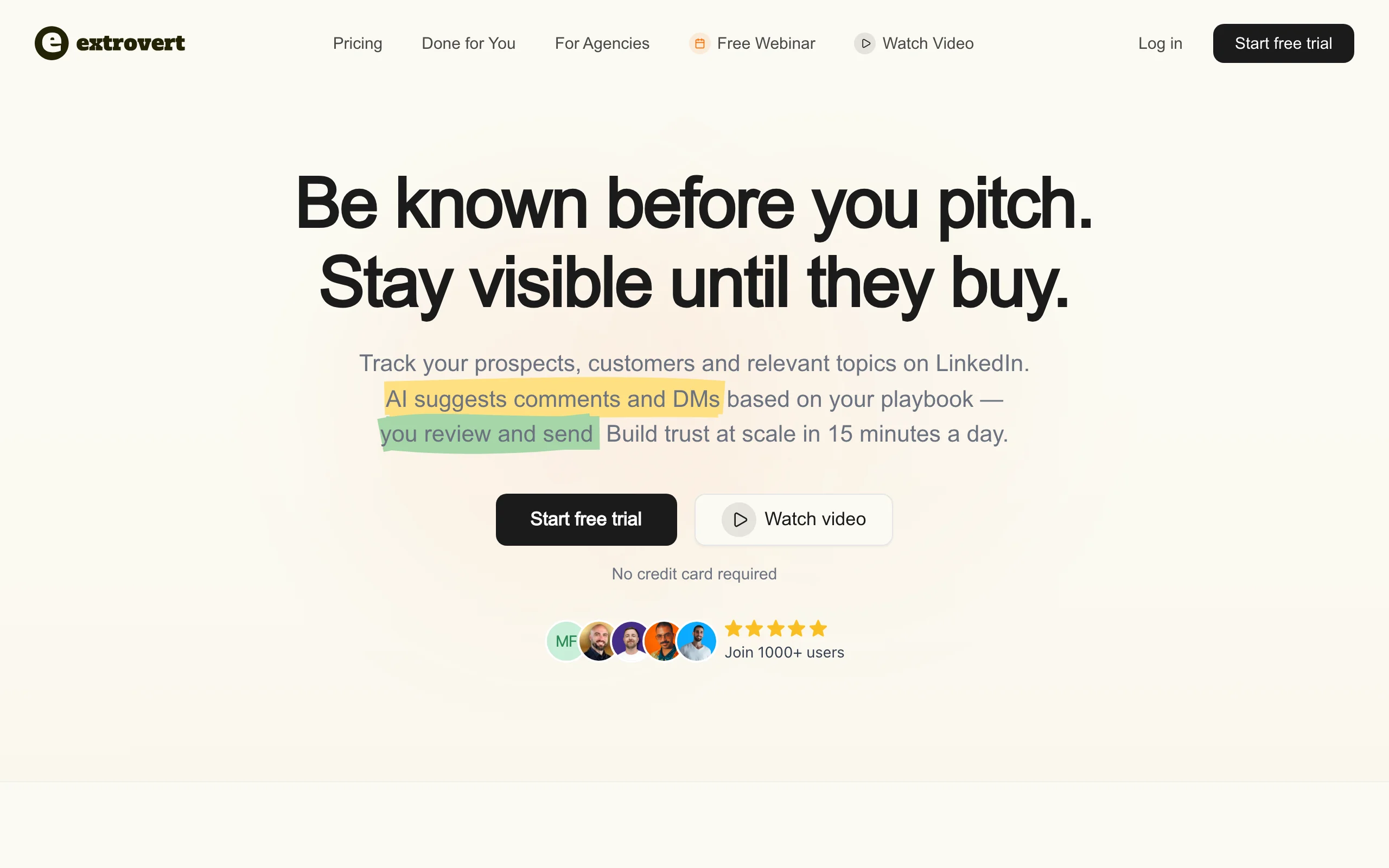
Extrovert is built for one thing: helping B2B sellers get known before they pitch. You connect your LinkedIn account, add the prospects, customers, and topics you want to track, and Extrovert surfaces their posts in a daily feed. The AI then suggests comments and DMs based on the playbook your team defines — your tone, your value props, your rules for what to say and what to avoid. The whole workflow takes about 15 minutes a day.
What separates Extrovert from generic LinkedIn automation tools is the human-in-the-loop design. Nothing posts automatically. You review every suggestion, edit it, and send it yourself — which keeps accounts safe and keeps the voice authentically yours. For SDRs building LinkedIn pipeline, this creates a compounding visibility effect: prospects start recognizing your name in their feed weeks before a cold DM arrives. That familiarity is the foundation of engagement-led prospecting, and it's what converts a cold DM into a warm one.
Key features:
- Prospect, customer, and topic tracking feeds
- AI comment and DM suggestions trained on your playbook
- Signal alerts: job changes, funding rounds, content triggers
- Human-in-the-loop: every message reviewed and sent by you
- 90-day engagement loop for consistent pipeline warmth
Best for:
- SDRs and AEs using LinkedIn as their primary prospecting channel
- Founders doing 15-20 minutes a day of relationship-led outbound
- Revenue teams burned by automation bans who want a ban-safe engagement workflow
Pricing:
- Free trial available
- From $35/month per seat
- Team and agency plans available
Pros:
- Keeps LinkedIn accounts safe: no automation, no bans
- Compresses daily LinkedIn engagement into a single focused session
- Builds familiarity before the DM lands, improving reply rates
Cons:
- LinkedIn-only: not a multichannel cold-email tool
- Best results require consistent daily use; sporadic sessions reduce the compounding effect
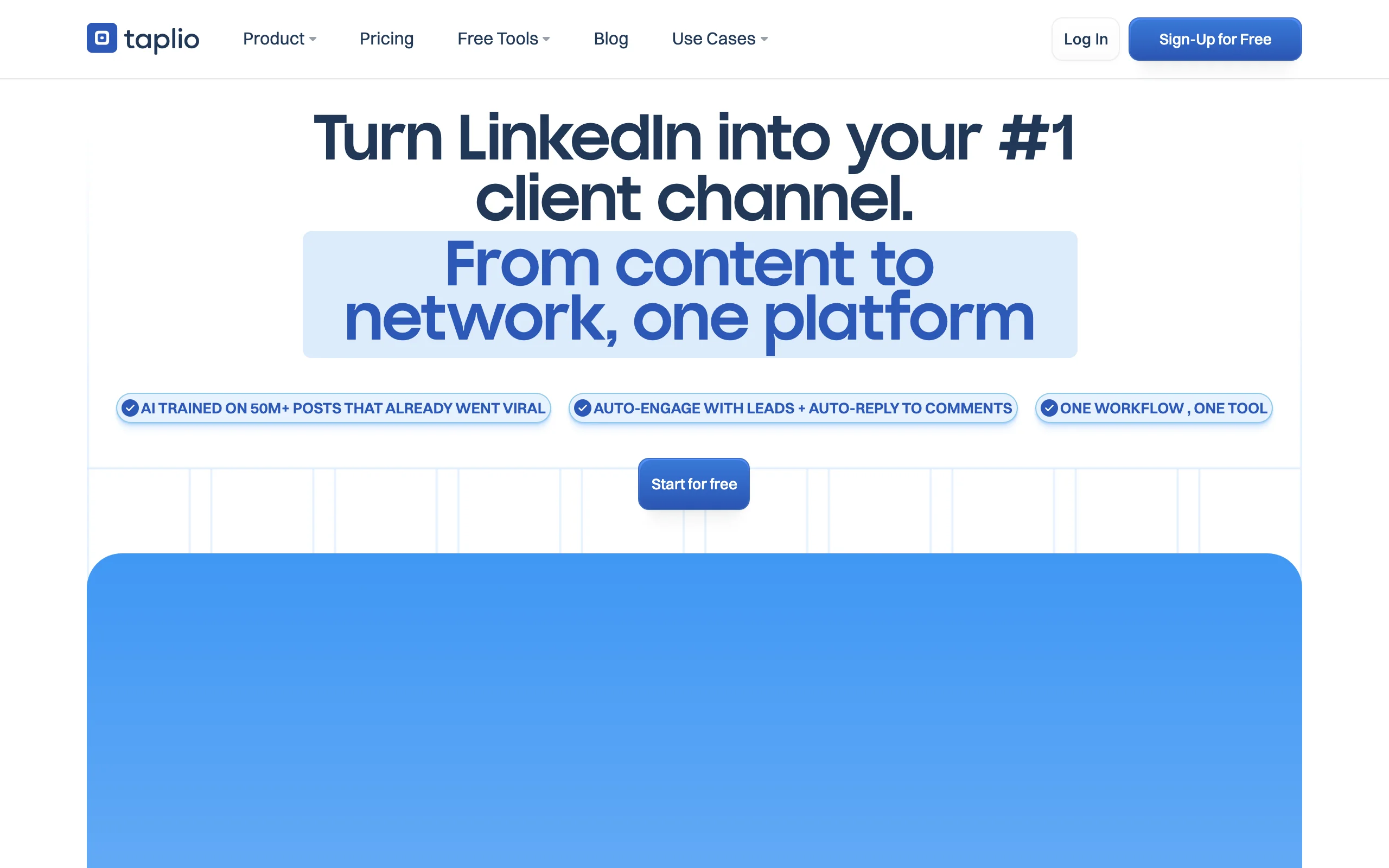
2. Taplio, best for LinkedIn personal brand and light DM sequences
Taplio is a LinkedIn content and engagement tool aimed at founders, consultants, and sellers who want to grow their presence through posting. It handles content scheduling, an AI-powered post generator, a lightweight CRM view of who engaged with your posts, and simple DM automation triggered by content engagement.
It's a strong fit for sellers who already know that personal-brand visibility drives inbound interest and want one platform to manage the content side. The carousel builder and post scheduler are genuinely good. The engagement tracking lets you see which prospects are reading your posts before you reach out. For straight one-on-one warm outreach, Taplio's playbook customization and prospect-level tracking are thinner than Extrovert's — the two tools address overlapping but distinct problems.
Key features:
- AI post generator and content calendar
- LinkedIn post scheduler and carousel builder
- Engagement-triggered DM automation
- Contact CRM showing who engaged with your content
- Analytics dashboard for post performance
Best for:
- Founders and consultants investing in audience growth as a pipeline channel
- Account executives building a personal brand alongside outbound
- Solo sellers who want content scheduling and light outreach in one tool
Pricing:
- From $39/month (14-day trial; no free tier)
- Team plans available
Pros:
- Strong content creation tools designed specifically for LinkedIn
- Combines scheduling and engagement tracking in one place
- Good for building top-of-funnel brand awareness over time
Cons:
- DM automation can trigger LinkedIn warnings at high volume
- CRM layer is shallow compared to dedicated prospect-tracking tools
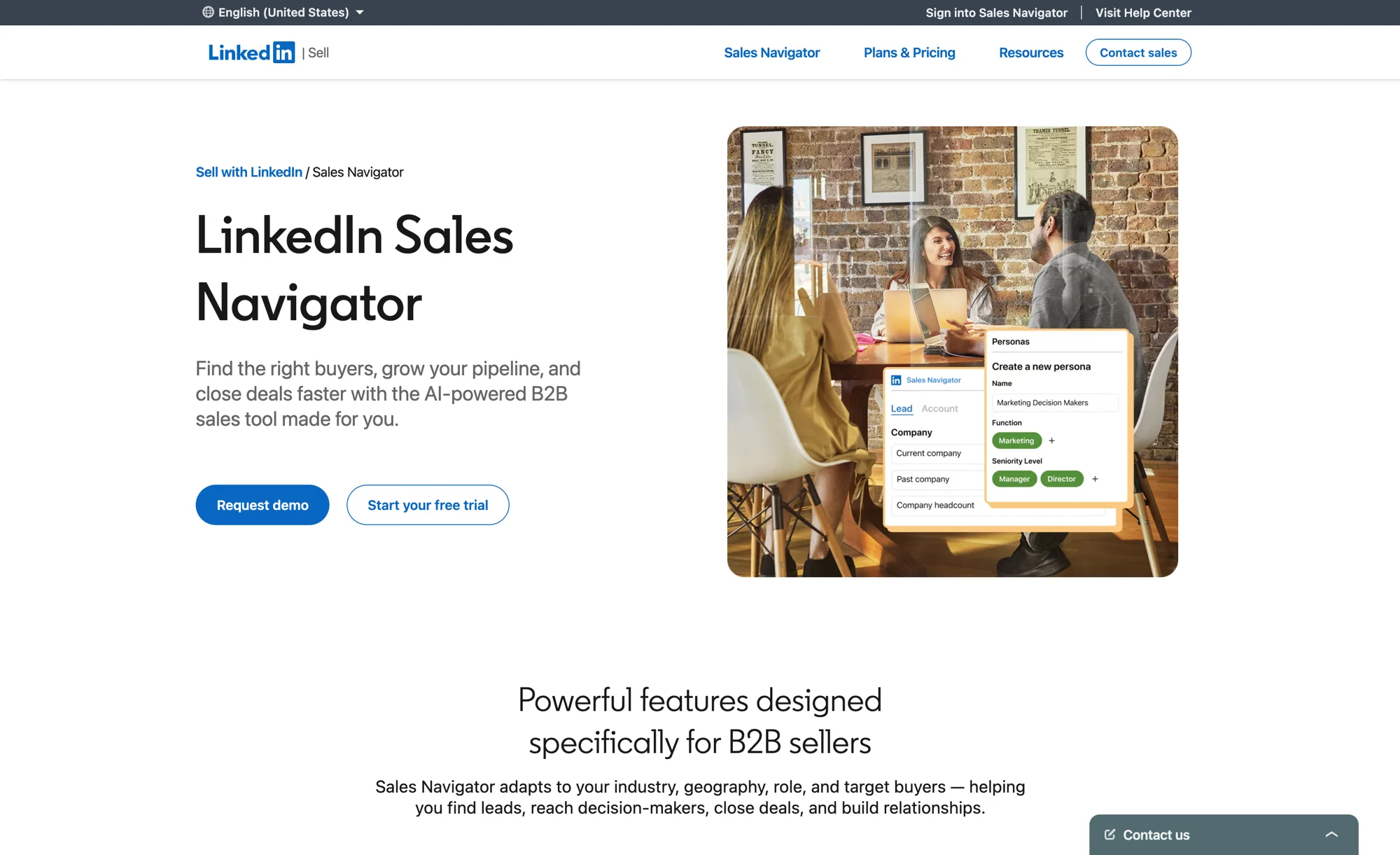
3. LinkedIn Sales Navigator, best for enterprise account mapping
Sales Navigator is LinkedIn's native paid product for sales teams. It gives you advanced search filters (company headcount, growth signals, CRM sync, seniority), relationship maps inside target accounts, saved Lead and Account lists, and real-time alerts when a prospect changes jobs or posts. For enterprise AEs working strategic accounts, it's often non-negotiable.
The data is LinkedIn's own, which means it's more current than third-party contact databases for job-change and seniority signals. One nuance: Sales Navigator tells you who to reach out to and when, but it doesn't help with what to say. Many teams pair it with Extrovert to act on signals through warm engagement rather than cold DMs. Your LinkedIn SSI score also factors into how Sales Navigator surfaces your profile in searches.
Key features:
- Advanced prospect and account search with 40+ filters
- Real-time alerts: job changes, company mentions, content engagement
- TeamLink: see shared connections across your org for warm introductions
- CRM sync with Salesforce and HubSpot
- Account maps for buying committee visualization
Best for:
- Enterprise AEs managing large named account lists
- SDR teams running account-based prospecting programs
- Revenue ops teams mapping buying committees across large organizations
Pricing:
- Core: from $119.99/seat/month
- Advanced and Advanced Plus (CRM sync, enterprise features): custom pricing
- 30-day free trial; no free tier
Pros:
- Best-in-class data freshness for LinkedIn-specific signals
- TeamLink surfaces warm introduction paths through existing connections
- Deep Boolean search for precise ICP targeting
Cons:
- Expensive at team scale; per-seat pricing compounds quickly for large teams
- Does not help with engagement or messaging — a separate tool solves that
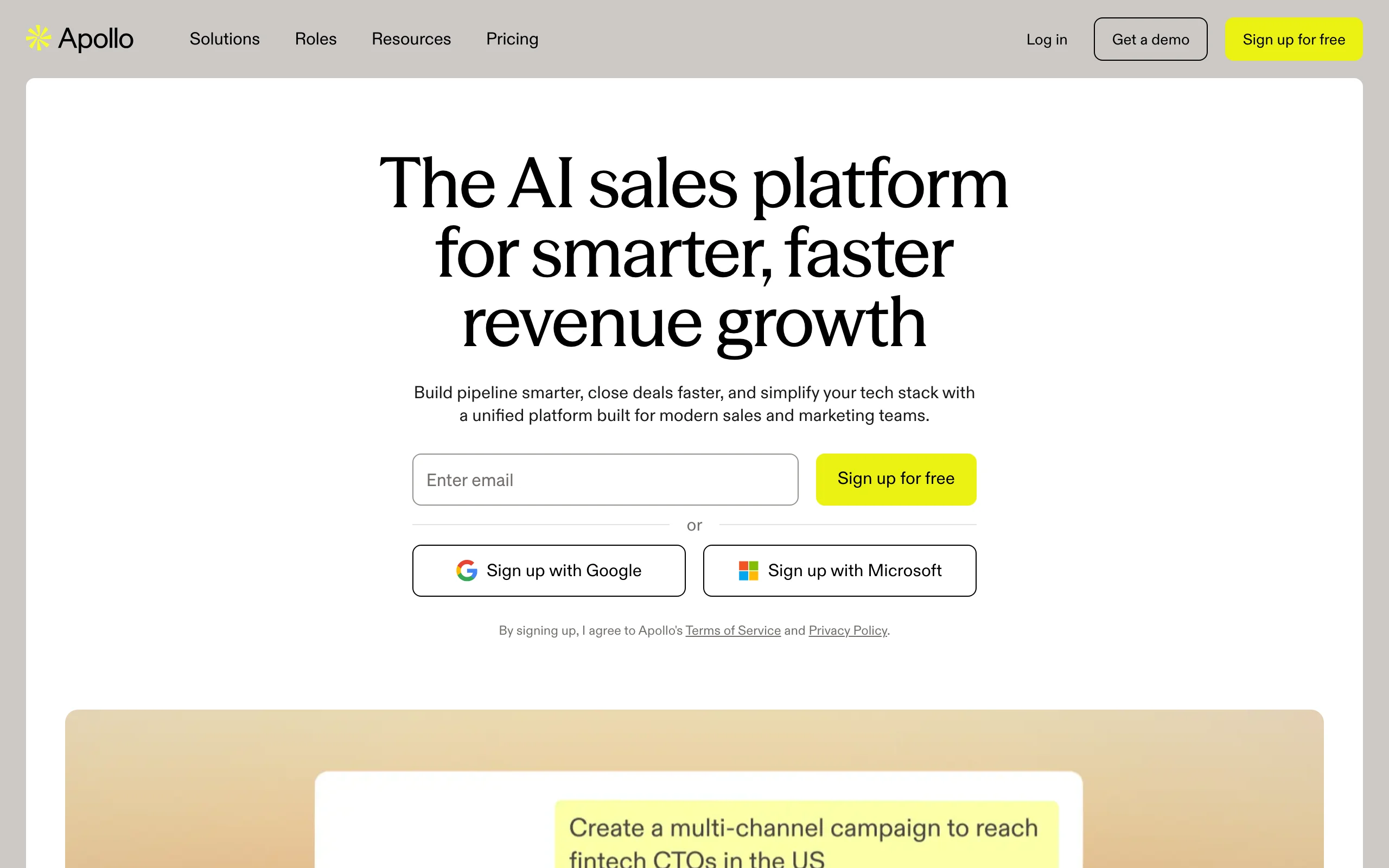
4. Apollo.io, best for all-in-one prospecting and sequencing
Apollo is arguably the best-value all-in-one prospecting platform in 2026. It combines a B2B contact database (300M+ contacts), email sequencing, a built-in dialer, LinkedIn automation steps, and basic CRM pipeline functionality. For SDR teams at Series A-B companies that can't yet justify ZoomInfo prices, Apollo covers most of the outbound stack in one subscription.
The platform improved significantly through 2024-2025: email deliverability, intent data, and the sequencing engine all received meaningful upgrades. The database has gaps at senior enterprise levels, but for mid-market ICP targeting it's hard to beat at the price point. In r/sales threads discussing lean sales stacks, Apollo consistently surfaces as the first recommendation for teams moving off manual prospecting (one recent thread had 200+ upvotes for Apollo as a ZoomInfo replacement at a fraction of the cost).
Key features:
- 300M+ contact database with verified emails and direct dials
- Multichannel sequences: email, LinkedIn steps, call tasks
- Built-in dialer and call recording
- Intent data and technographic filters for ICP precision
- Basic deal pipeline to track prospects through close
Best for:
- SDR teams at startups and scale-ups with budget constraints
- Founder-led sales where one tool needs to do the work of three
- Teams consolidating data and sequencing to reduce stack complexity
Pricing:
- Free tier: 50 email credits/month
- Basic: from $49/seat/month
- Professional: from $79/seat/month
Pros:
- Exceptional value: replaces three or more tools at a competitive price
- Consistent product improvement with a strong community and documentation
- Intent data filters help prioritize prospects already researching your category
Cons:
- Database quality drops for senior enterprise contacts at large companies
- LinkedIn automation steps carry standard account-restriction risk without a dedicated warm-outreach layer
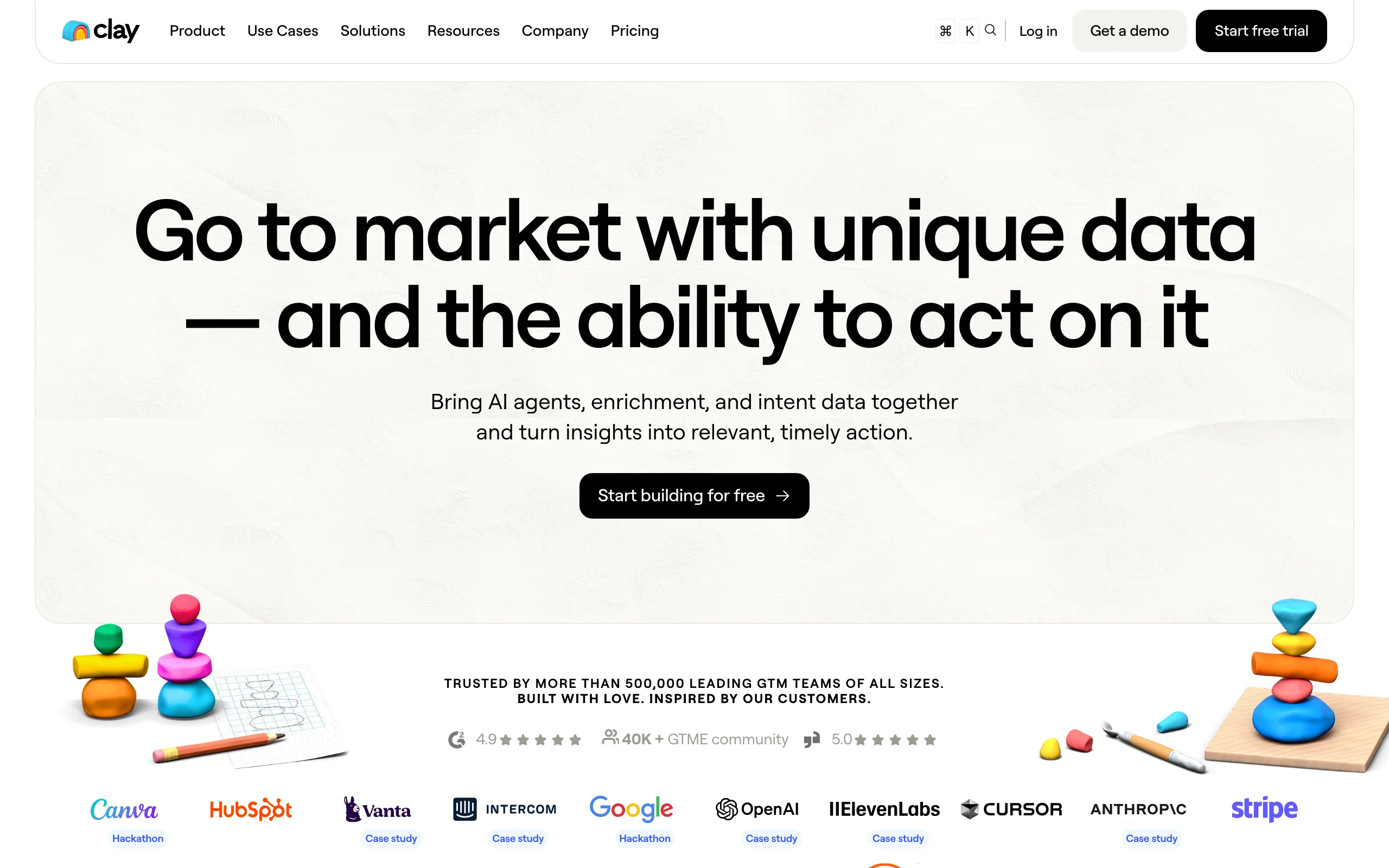
5. Clay, best for hyper-personalized prospecting at scale
Clay is a data enrichment and outbound personalization platform that sits between your contact list and your sequencing tool. You import a prospect list, Clay pulls data from 50+ sources (LinkedIn, Apollo, Clearbit, news APIs, job postings, funding data, and more), and you use built-in AI to write first lines or dynamic variables based on actual research about each prospect. The result: genuinely personalized emails at volume, without a researcher per rep.
Clay is operations-heavy to configure but powerful once running. It works best when you have a clear ICP and want to send 50-200 highly targeted emails per week rather than 1,000 generic ones. In r/b2bsaas discussions on outbound efficiency, Clay frequently appears as the tool that changed the math on quality versus quantity for SDR teams (threads from late 2025 cite Clay-enriched campaigns running 3-5x higher reply rates than generic sequences).
Key features:
- 50+ data enrichment sources in a single workflow
- Waterfall enrichment: tries source A, falls back to source B automatically
- AI-generated first lines and dynamic personalization variables
- Direct exports to Outreach, Salesloft, Lemlist, and Smartlead
- Custom webhooks for any sequencing tool
Best for:
- Ops-savvy SDR teams and RevOps builders
- AEs running highly targeted, low-volume outbound to strategic accounts
- Growth teams that want personalization quality without hiring researchers
Pricing:
- Free tier: 100 credits/month
- Starter: from $149/month
- Explorer and above: usage-based pricing
Pros:
- Dramatically reduces per-prospect research time
- Personalization quality that outperforms generic cold email at scale
- Modular: use only the enrichment sources your ICP requires
Cons:
- Steep learning curve; requires ops knowledge to build effective tables
- Credit costs scale quickly at high volume; budget carefully before committing
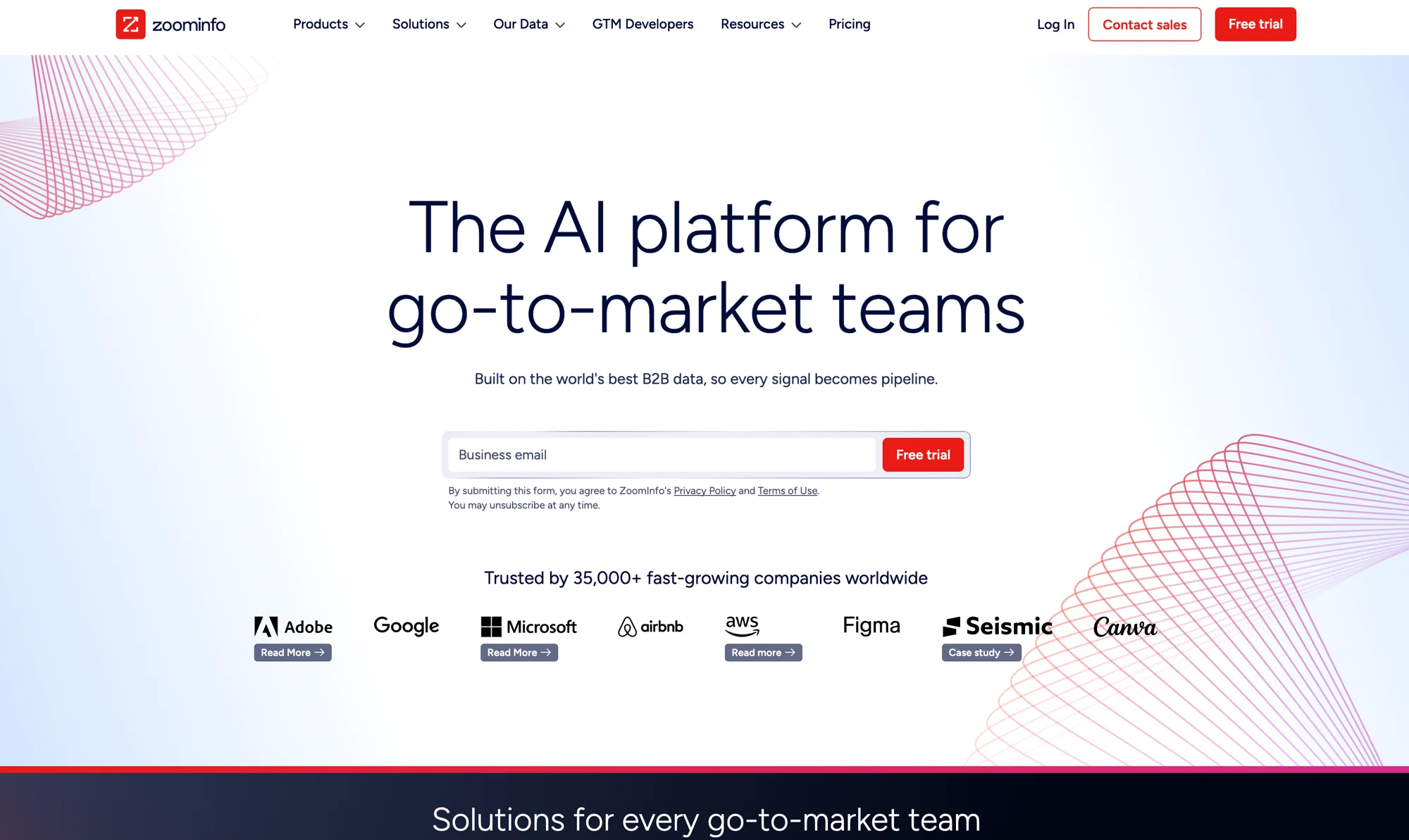
6. ZoomInfo Sales, best for enterprise B2B data and intent signals
ZoomInfo is the enterprise standard for B2B contact and company data. Its database covers more organizations, has better direct-dial coverage for senior contacts, and layers in intent data (topics prospects are actively researching) in a way few competitors match at scale. Large revenue teams use ZoomInfo as the data foundation that feeds their CRM, sequencing tools, and territory planning.
The price reflects the product. ZoomInfo carries minimum contract commitments that put it out of reach for most startups. For teams with the budget, it reduces bad-data problems and surfaces buying-signal timing that improves outbound efficiency. Intent data alone can prioritize sequences toward accounts showing active research behavior, reducing wasted reach on contacts with no current buying motion.
Key features:
- Comprehensive B2B contact database with direct dials and verified emails
- Intent data: topics target accounts are actively researching now
- CRM integrations with Salesforce, HubSpot, and Microsoft Dynamics
- Scoops: hiring signals, technology installs, leadership changes
- Buying committee and org chart mapping
Best for:
- Enterprise revenue teams with $20k+ annual data budgets
- SDR managers where bad contact data is a recurring bottleneck
- Orgs running account-based programs that depend on signal timing
Pricing:
- Custom pricing only; typical starting contracts around $15,000-25,000/year
- No free tier
Pros:
- Industry-leading data coverage and intent signal quality
- Scoops surface actionable triggers that generic databases miss
- Deep CRM integrations reduce manual data entry for ops teams
Cons:
- Expensive and contractual; poor fit for startups and SMB teams
- Intent data quality varies meaningfully by vertical and company size
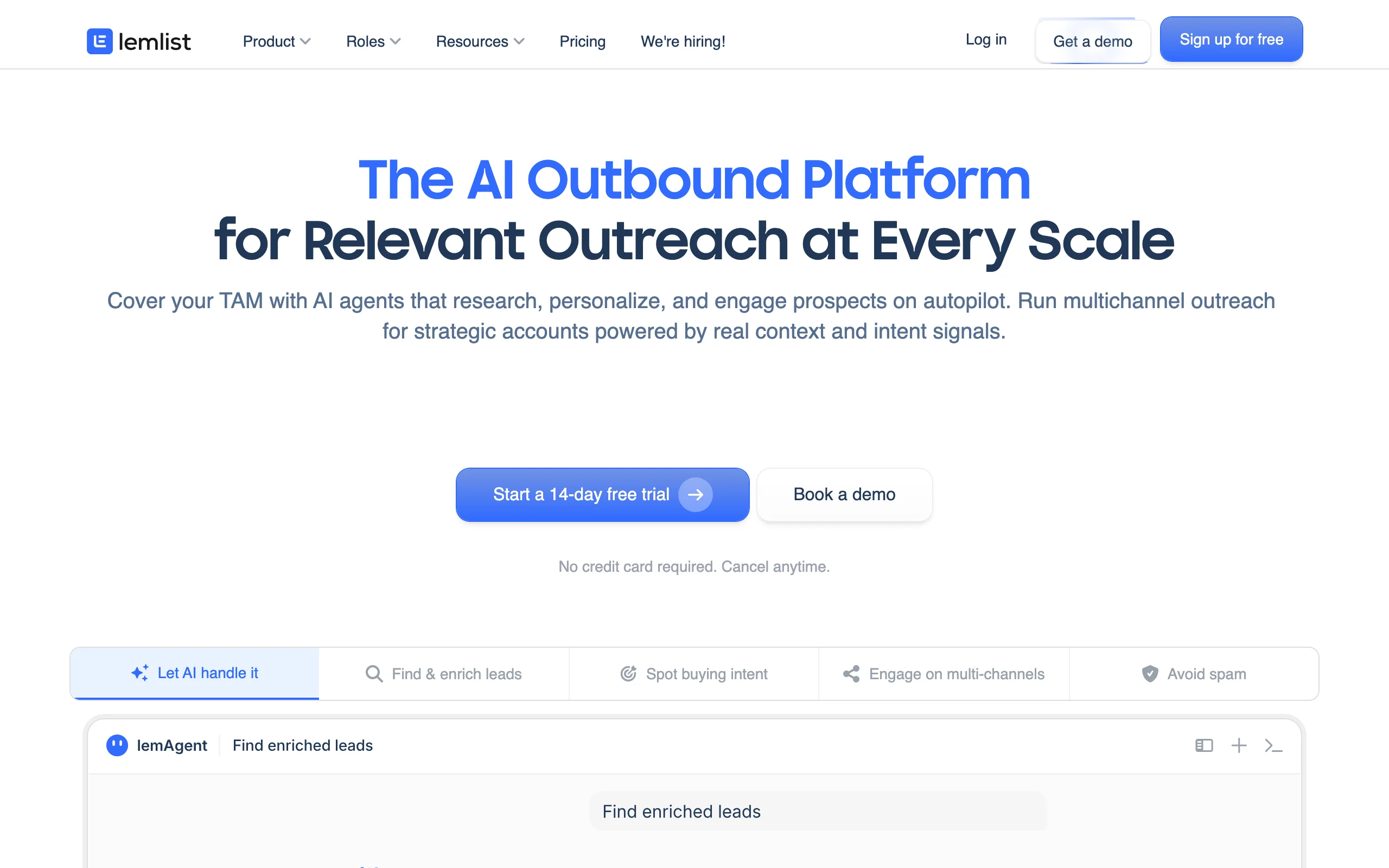
7. Lemlist, best for multichannel cold outreach sequences
Lemlist is a cold outreach platform built around email, LinkedIn, and video in one sequence. The personalization features — personalized images, custom intro lines, liquid syntax variables — were ahead of the market when the product launched and still hold up well. It targets sales teams that want to add LinkedIn touchpoints and video intro clips alongside email without paying enterprise-platform prices.
Recent updates added an AI sequence builder that generates a full multichannel cadence from an ICP description. Output quality varies and usually needs editing, but it's a reasonable starting point for teams building their first structured outbound motion. For a lean SDR team running high-volume outbound, lemlist's per-seat price and feature set hit the right balance.
Key features:
- Multichannel sequence steps: email, LinkedIn, and cold call tasks
- Personalized images and video clips in email body
- AI sequence builder from ICP description
- Liquid syntax variables for dynamic personalization at scale
- Built-in inbox warming via lemwarm
Best for:
- SDR teams running multichannel outbound at moderate volume (under 500 emails/day)
- AEs adding LinkedIn touchpoints to existing email sequences
- Teams that want video outreach without purchasing a separate tool
Pricing:
- Free tier: limited sends
- Email Outreach: from $63/seat/month (annual)
- Multichannel Expert: from $87/seat/month (annual)
Pros:
- Multichannel sequences without enterprise pricing
- Personalized images and video differentiate outreach in crowded inboxes
- Strong deliverability features with lemwarm integration
Cons:
- LinkedIn automation steps carry account-restriction risk on older or primary accounts
- AI sequence builder produces generic output that needs significant editing before sending
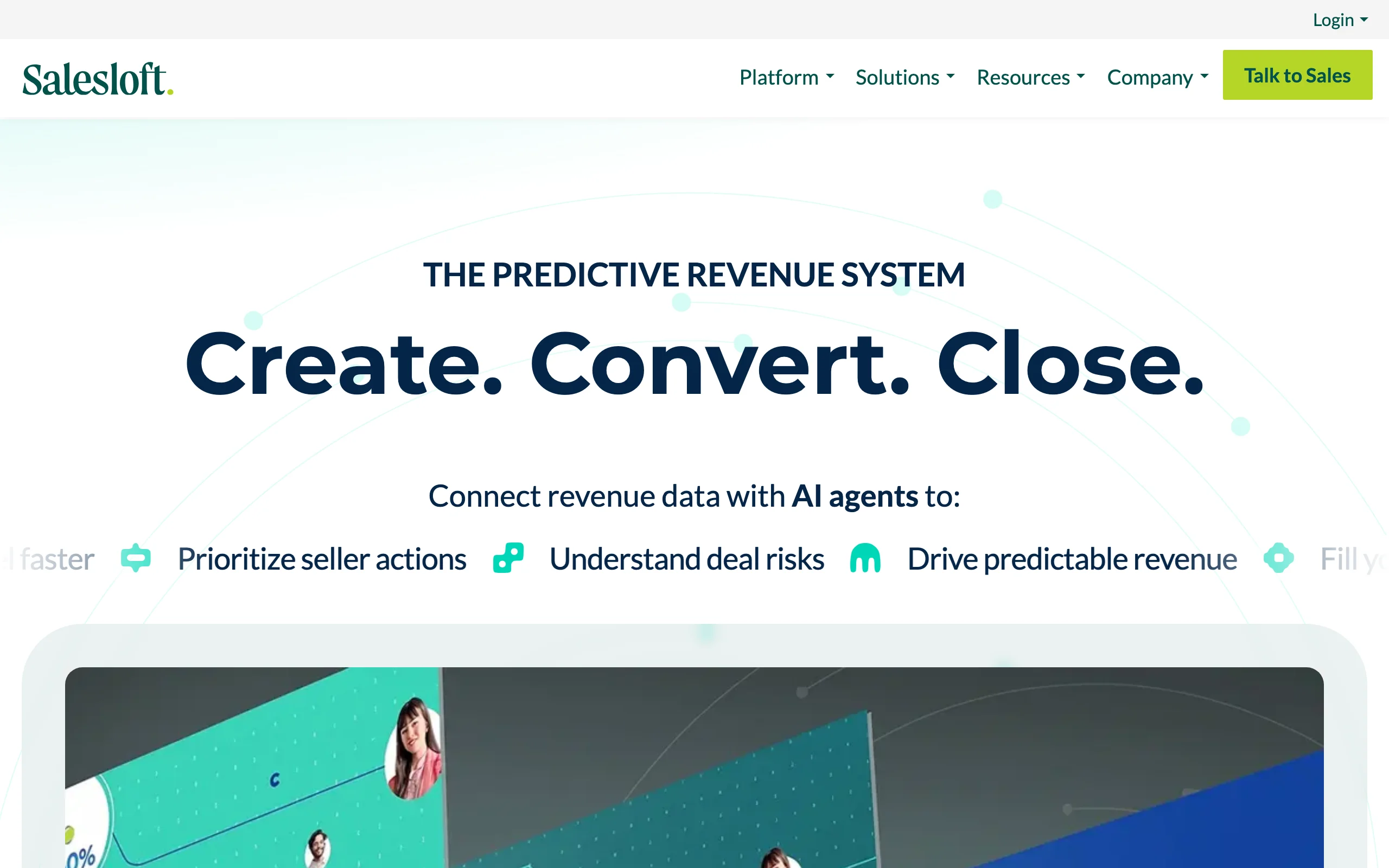
8. Salesloft, best for full sales engagement platform
Salesloft is a revenue workflow platform used by mid-market and enterprise sales organizations. It covers cadences (email, call, LinkedIn, SMS), deal management, conversation intelligence with AI call summaries, forecasting, and rep coaching in one platform. It competes directly with Outreach and suits orgs that want to consolidate their stack rather than bolt together point solutions.
Salesloft's strength is cross-team coordination: SDR cadences hand off cleanly to AE deal rooms, and managers get pipeline visibility without pulling data from five tools. The flip side is complexity and cost — it requires a dedicated admin to get full value, and the contract commitment most startups avoid.
Key features:
- Multichannel cadences: email, call, LinkedIn, SMS
- Deal rooms and pipeline management with health scoring
- Conversation intelligence with AI coaching and transcription
- Revenue forecasting and pipeline analytics
- Plays: automated workflow triggers based on rep activity and deal stage
Best for:
- Mid-market and enterprise SDR/AE orgs with dedicated RevOps or Sales Ops
- Teams consolidating cadences and deal management in one platform
- Sales managers who need performance dashboards and coaching data
Pricing:
- Custom pricing; typically $125-175/seat/month at mid-market scale
- No free tier
Pros:
- Deep cross-team coordination between SDR and AE motions
- Strong conversation intelligence with actionable coaching features
- Reliable deliverability and compliance tooling for regulated industries
Cons:
- Complex to administer; underdelivers without a dedicated admin
- Expensive for teams that only need cadences; Apollo covers that use case for a fraction of the cost
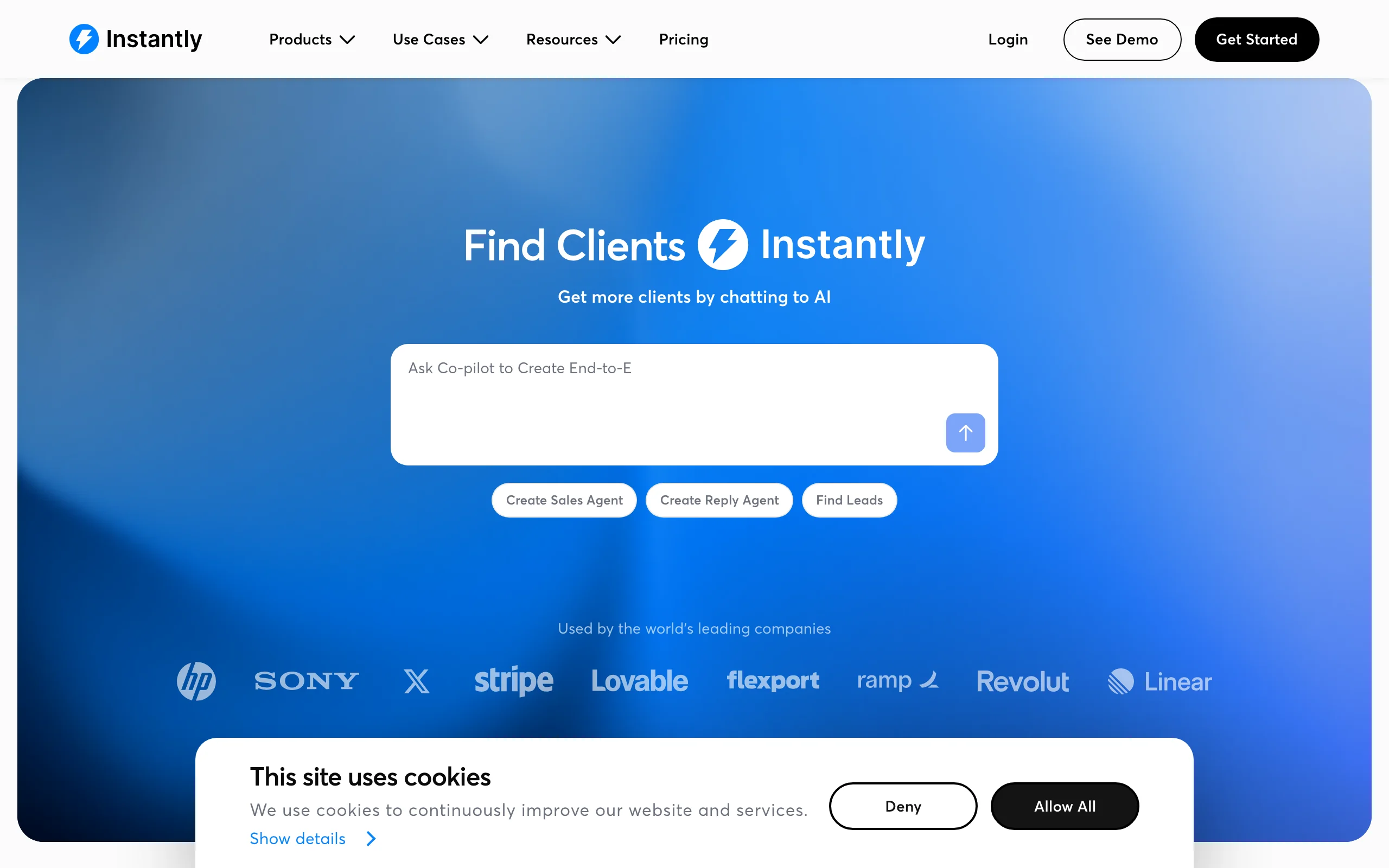
9. Instantly.ai, best for high-volume cold email infrastructure
Instantly.ai is a cold email platform built around deliverability infrastructure: unlimited email sending accounts, automated inbox warming across all accounts, rotation across multiple domains, and a clean sequencing layer on top. It's the tool behind high-volume cold email agencies and teams sending thousands of emails per week who need inbox placement rates to hold up over time.
What you don't get: LinkedIn steps, deep CRM integration, or conversation intelligence. Instantly is deliberately focused on one problem — sending a lot of cold emails that land in the inbox. For teams that have validated their message and want to scale volume without Salesloft prices, it's an excellent infrastructure choice. The unified reply inbox (Unibox) manages replies across all connected accounts in one view.
Key features:
- Unlimited email sending accounts on all paid plans
- Automated inbox warming for every connected account
- Email rotation across multiple domains for deliverability
- Unibox: unified reply management across all accounts
- Basic A/B testing for subject lines and email body
Best for:
- High-volume cold email agencies managing multiple clients
- Founders and SDRs sending 1,000+ emails per week
- Teams building cold email infrastructure without paying for features they don't need
Pricing:
- Growth: from $37/month
- Hypergrowth: from $77/month (unlimited accounts and warmup)
Pros:
- Best deliverability infrastructure in the category for high-volume sending
- Unlimited email account support at a low monthly cost
- Clean, focused UI that reduces onboarding time
Cons:
- Email-only: no LinkedIn steps, no dialer, no intelligence layer
- Still requires high-quality prospect lists from a separate data tool to perform
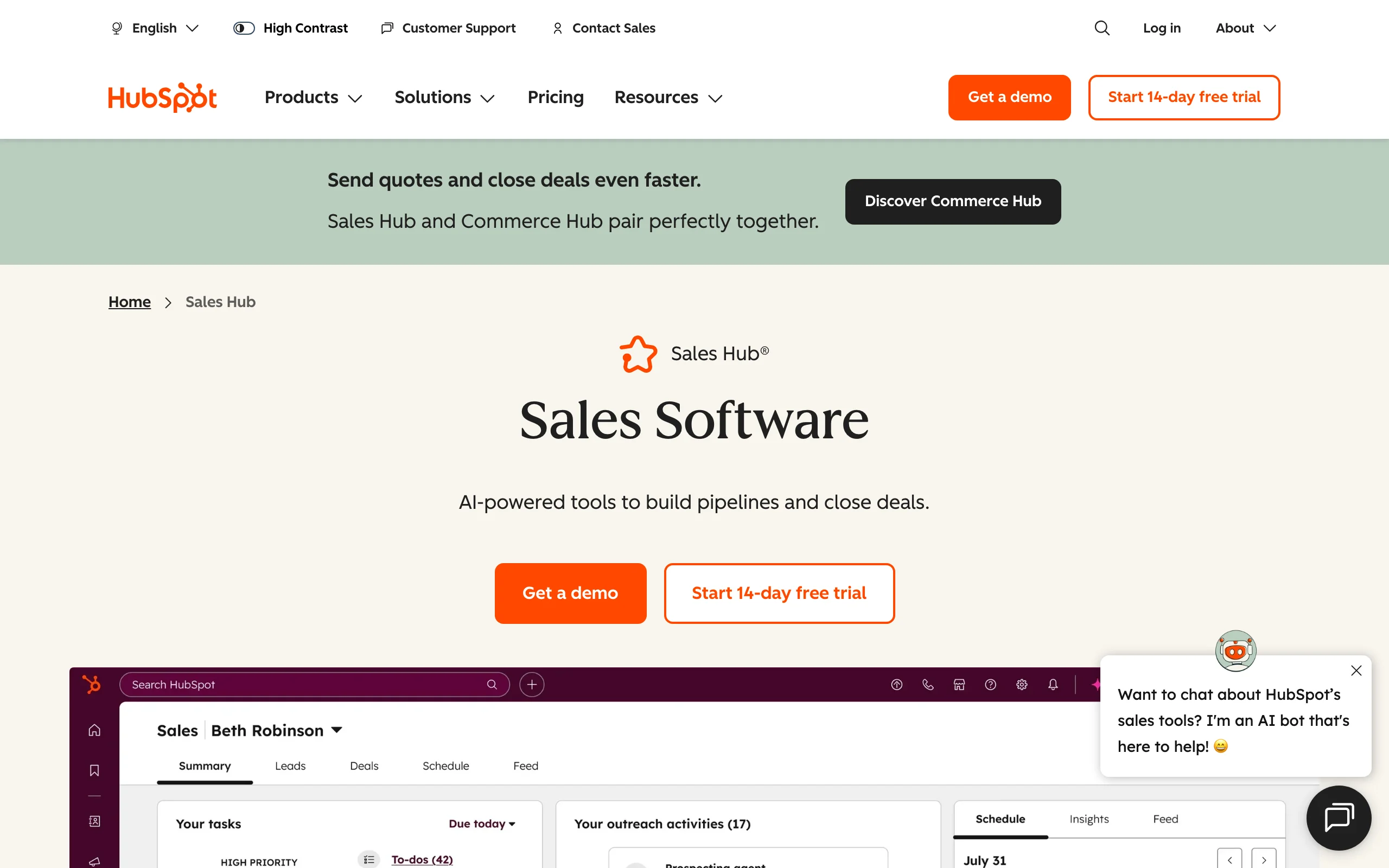
10. HubSpot Sales Hub, best for SMB and mid-market CRM
HubSpot Sales Hub is the default CRM choice for B2B companies that want sales and marketing on the same platform. The free CRM is genuinely useful: contact management, deal tracking, email templates, and meeting scheduling with no seat cap. Paid tiers add sequences, call recording, CPQ, and predictive lead scoring.
The killer feature is the shared data model with HubSpot Marketing Hub: every touchpoint (email open, form fill, ad click, sales call) lands in one contact record. For founder-led teams and SMBs with short sales cycles and an active marketing function, that tight alignment is hard to replicate by bolting Salesforce and Marketo together. It's also the easiest CRM to get a new rep productive on — most teams are running within a day.
Key features:
- Contact, company, and deal management with no seat cap on the free tier
- Email sequences, templates, and tracking
- Meeting scheduler and live chat
- Deal pipeline with custom stages and automation
- Full contact timeline combining marketing and sales touchpoints
Best for:
- SMBs and Series A-B companies with a shared sales and marketing team
- Founders who want a CRM without hiring a dedicated admin
- Inbound-heavy teams where marketing-to-sales lead handoff matters
Pricing:
- Free tier: unlimited contacts, core features
- Starter: from $15/seat/month
- Professional: from $90/seat/month
Pros:
- Best-in-class free tier — usable from day one with no credit card
- Tight integration with HubSpot Marketing for full-funnel contact visibility
- Fast onboarding with a large library of tutorials and community support
Cons:
- Gets expensive at scale; Professional and Enterprise tiers add up quickly for larger teams
- Customization depth is shallower than Salesforce for complex enterprise workflows
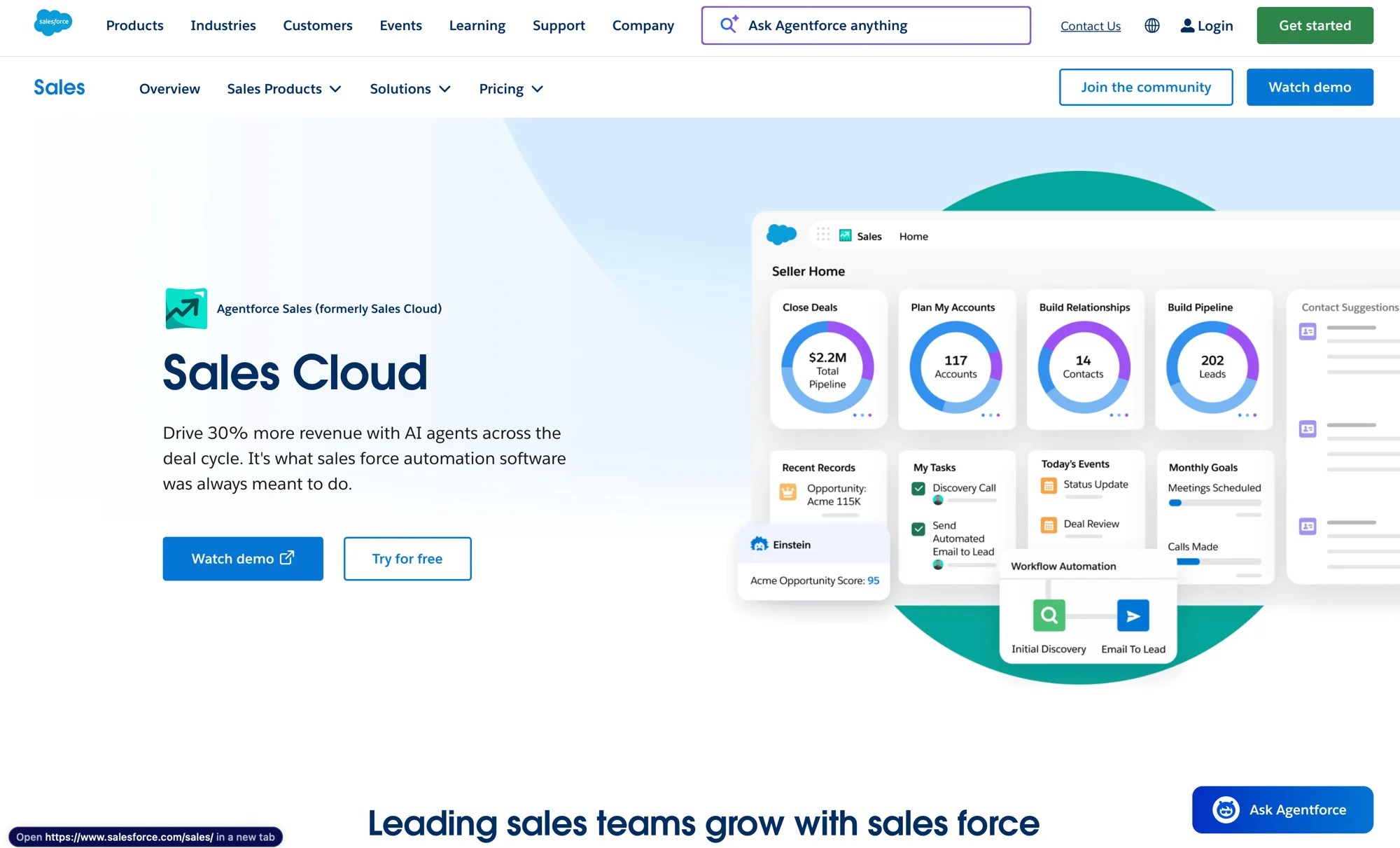
11. Salesforce Sales Cloud, best for enterprise CRM with deep customization
Salesforce is the enterprise CRM standard for a reason: it handles virtually any sales workflow, object model, or integration you can design. Sales Cloud covers lead and opportunity management, territory assignment, CPQ, revenue forecasting, and through AppExchange, integrations with every other tool in this list.
The tradeoff has been consistent for two decades. Salesforce is powerful and flexible, but it requires investment. Licenses, admin overhead, implementation costs, and the time to customize it for your process add up fast. For companies with 20+ reps, complex multi-team workflows, or regulatory requirements, that investment pays off. For everyone else, HubSpot or Pipedrive reach value faster.
Key features:
- Full lead, opportunity, and territory management
- CPQ (Configure, Price, Quote) and revenue forecasting
- AppExchange: 3,000+ third-party integrations
- Einstein AI: predictive lead scoring and opportunity insights
- Fully customizable objects, workflows, and approval processes
Best for:
- Enterprise orgs with dedicated Salesforce admins or a RevOps team
- Companies with complex multi-product, multi-team sales motions
- Orgs with compliance or audit requirements that demand a fully configurable CRM
Pricing:
- Starter: from $25/seat/month
- Professional: from $80/seat/month
- Enterprise: from $165/seat/month (most complete feature set)
Pros:
- Most flexible and extensible CRM on the market
- AppExchange covers integration with every major tool in the B2B sales stack
- Industry-leading forecasting and territory management for large team structures
Cons:
- High total cost of ownership when admin, implementation, and license fees stack
- Overkill for teams under 20 reps; the complexity slows early-stage teams down
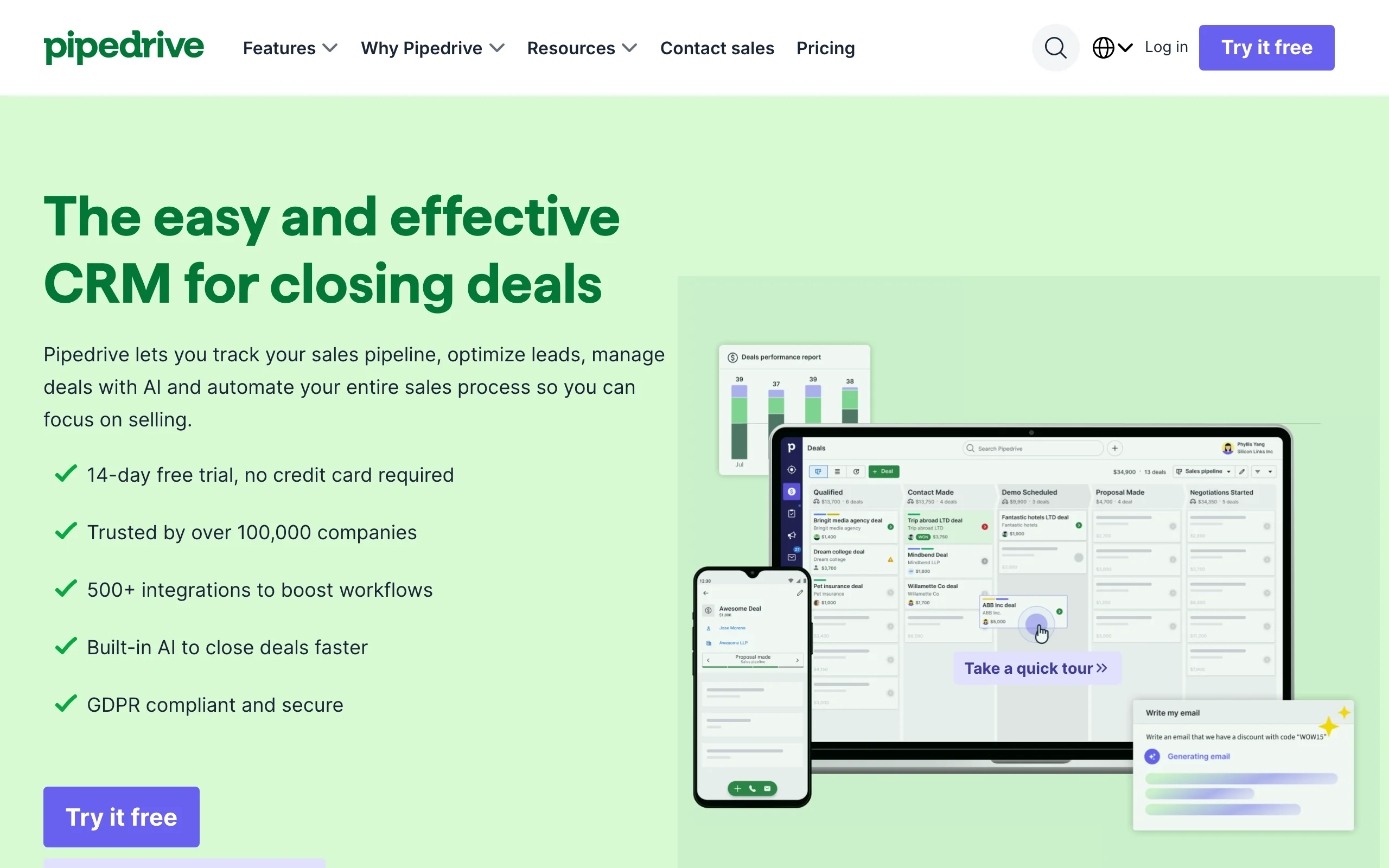
12. Pipedrive, best for visual pipeline management
Pipedrive is a sales-first CRM built around a visual deal pipeline rather than a contact database. Every action in the interface is oriented around moving deals forward: what's the next activity, what stage is this deal in, what's blocking it. For AEs and small sales teams who live in their pipeline rather than their inbox, this clarity is genuinely different from HubSpot or Salesforce.
The automation layer handles repetitive tasks: creating follow-up activities, sending templated emails on stage change, and notifying managers on stalled deals. Pricing is transparent and predictable with no surprise contact limits or feature gates at the starter tier — which matters for teams that have been burned by HubSpot's scaling costs before.
Key features:
- Visual, Kanban-style deal pipeline with drag-and-drop stages
- Activity-focused workflow: calls, meetings, and tasks linked directly to deals
- Email sync and template library
- Automations triggered by deal stage changes or inactivity
- LeadBooster add-on: chatbot and web forms for inbound lead capture
Best for:
- AEs and small sales teams (two to twenty reps)
- Teams that tried Salesforce and found it too heavy for their process
- B2B sales motions with clear, repeatable pipeline stages
Pricing:
- Essential: from $14/seat/month
- Advanced: from $34/seat/month
- Professional: from $49/seat/month
Pros:
- Cleanest pipeline UX in the CRM category — minimal training required
- Transparent pricing with no contact caps at the entry tier
- Fast onboarding; most teams are productive within a single day
Cons:
- Reporting and forecasting are thin compared to Salesforce or HubSpot Professional
- Less suitable for complex enterprise workflows or organizations with multiple sales teams
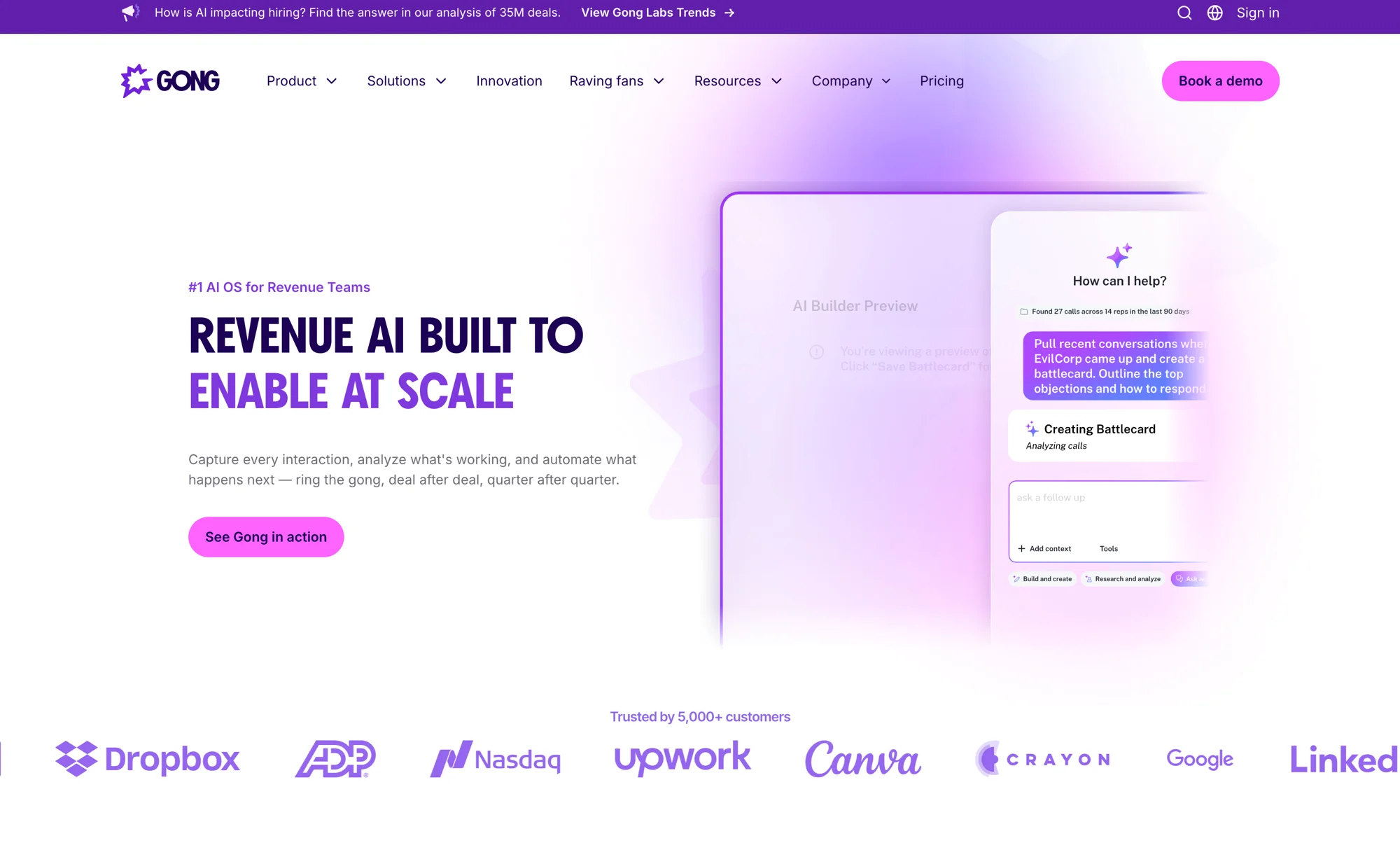
13. Gong, best for revenue intelligence and rep coaching
Gong records sales calls, transcribes them, analyzes conversation patterns, and surfaces deal risks, competitor mentions, and coaching opportunities. For sales managers, it replaces the impossible task of listening to 20% of calls manually — Gong flags the ones that need attention, identifies which objection patterns lead to closed-lost, and generates next-step summaries so nothing falls through.
Conversation intelligence has expanded significantly: Gong now covers deal execution, forecast accuracy, and pipeline health alongside call analysis. Its value compounds over time as the model learns your team's patterns. A recurring theme in r/sales discussions on management tools: Gong is the first thing teams keep when budget gets cut, because it directly surfaces coaching moments that improve rep quota attainment.
Key features:
- Call recording and AI transcription with speaker identification
- Deal health scoring and at-risk deal flags
- Pipeline analysis and forecast accuracy tools
- Rep scorecards and manager coaching workflows
- Competitor and objection tracking across all recorded calls
Best for:
- Sales managers at teams of 10 or more reps where manager bandwidth is the bottleneck
- AE teams with complex, multi-call sales cycles of 30 days or more
- Orgs where forecast accuracy is a recurring conversation at the leadership level
Pricing:
- Custom pricing; typically $100-200/seat/month depending on team size and volume
- No free tier; demo-gated
Pros:
- Dramatically reduces time to identify coaching moments at scale
- Deal risk flags improve forecast accuracy as the model learns your pipeline patterns
- Competitor mention tracking feeds product and marketing intelligence
Cons:
- Expensive and requires full team adoption to return meaningful data
- Limited ROI in the first 60 days; value compounds as the dataset grows
How to choose the right B2B sales tools for your team
Start with your motion, not your wishlist
Before comparing features, clarify what your primary sales motion is. If you're doing LinkedIn-led warm outbound, the tool foundation is different from a high-volume cold-email operation or an inbound-heavy team closing leads from marketing. Tools optimized for one motion often underperform in another.
A rough starting stack by motion:
- LinkedIn-led warm outbound: Sales Navigator for signal tracking, Extrovert for engagement, HubSpot or Pipedrive for CRM
- High-volume cold email outbound: Apollo or Clay for data, Instantly.ai or Lemlist for sequencing, CRM of your choice
- Full SDR/AE motion at scale: ZoomInfo for data, Salesloft for cadences, Salesforce for CRM, Gong for coaching
- Founder-led, low-volume, high-precision: Sales Navigator, Extrovert, Pipedrive or HubSpot Starter
Match tool tier to team size
Most early-stage teams over-invest in enterprise tooling before the motion is proven. A team of three to five SDRs doesn't need Salesforce, ZoomInfo, and Salesloft. Start with Apollo (data and sequencing), HubSpot Free (CRM), and one LinkedIn engagement tool. Add ZoomInfo and Salesloft when you've validated the ICP and built a repeatable process.
Prioritize ban-safety for LinkedIn
LinkedIn's enforcement on automation tools intensified through 2024-2025. Tools that post, like, or send messages automatically without human review carry real risk of account restriction. If LinkedIn is a primary channel, prioritize human-in-the-loop tools over full automation. Losing a rep's established LinkedIn account costs more than any tool saves. The LinkedIn for B2B sales motion works best when engagement is genuine and account health is protected.
Count total cost of ownership, not just seat price
Salesloft at $150/seat/month, Salesforce at $165/seat/month, and ZoomInfo at $400/seat equivalent totals $715/seat before admin cost. Apollo ($79), HubSpot Free, and Extrovert ($49) combine to $128/seat and cover most of the same jobs to be done for early-stage teams. The enterprise stack earns its cost when team size, process maturity, and data requirements justify it — not before.
Run pilots on real accounts
Don't benchmark tools on demo data. Run 30-day pilots on real accounts with real prospects. Measure reply rate, booked meetings, and for LinkedIn tools, whether your engagement is building visible familiarity before outreach lands. Numbers from real accounts are the only evaluation that matters.
FAQ
What is the best B2B sales tool for SDRs?
Depends on the outbound motion. For LinkedIn-led outbound, the combination of LinkedIn Sales Navigator (signal tracking) and Extrovert (engagement and warm outreach) covers prospecting and relationship-building. For high-volume cold email, Apollo.io is the best value all-in-one at the SDR tier: contact database, email sequencing, and a dialer at a price most startups can justify. Most SDR teams eventually combine both approaches as the motion matures. See how SDRs building LinkedIn pipeline structure the workflow.
Do I need a full sales stack or just one tool?
Most teams should start with one tool and add as they scale. A solo founder can close meaningful pipeline with just Apollo or HubSpot Free. The full stack (data, sequencing, CRM, intelligence, LinkedIn engagement) only pays off when process is proven, team is five or more reps, and you know exactly which part of the funnel needs optimization. Adding tools too early creates confusion, not coverage.
What B2B sales tools work best with LinkedIn?
Three categories layer together naturally:
- LinkedIn Sales Navigator for prospect search and real-time signal alerts
- Extrovert for acting on those signals through warm comments and DMs from your playbook
- Apollo or Clay for enriching LinkedIn-sourced contacts with verified email and phone data
That stack covers discovery (Sales Navigator), engagement (Extrovert), and enrichment (Apollo/Clay) without overlapping. All three connect to your CRM.
Is ZoomInfo worth it for a startup?
Typically not until you're at 15 or more reps with a validated ICP and a budget above $20k/year. Apollo covers 80% of ZoomInfo's database for 10-15% of the cost at early stages. ZoomInfo's value is in direct-dial accuracy, intent data quality, and Scoops for enterprise-level account targeting. Until those signals are the specific bottleneck in your outbound process, Apollo is the better investment.
What is the difference between cold outreach tools and LinkedIn engagement tools?
Cold outreach tools (Apollo, Lemlist, Instantly.ai) automate sequences of messages to cold prospects who don't know you. LinkedIn engagement tools like Extrovert work the opposite way: they help you build visibility with prospects before any direct message arrives, through consistent, relevant comments and interactions in their feed. Engagement-led prospecting treats the comment as the first touchpoint, not the DM. For most B2B sellers, the highest-performing motion combines both: build familiarity through engagement, then convert it with a warm DM that references your prior interaction. That sequence is the core of warm outreach done well.