Most teams treat their ICP as a list of firmographics: industry, company size, stage of growth. That definition is useful, it sets a focus, but it is incomplete. It tells you who to aim at and nothing about who is ready to move. It misses urgency, tension, and switching readiness, which are the things that actually decide whether a deal happens.
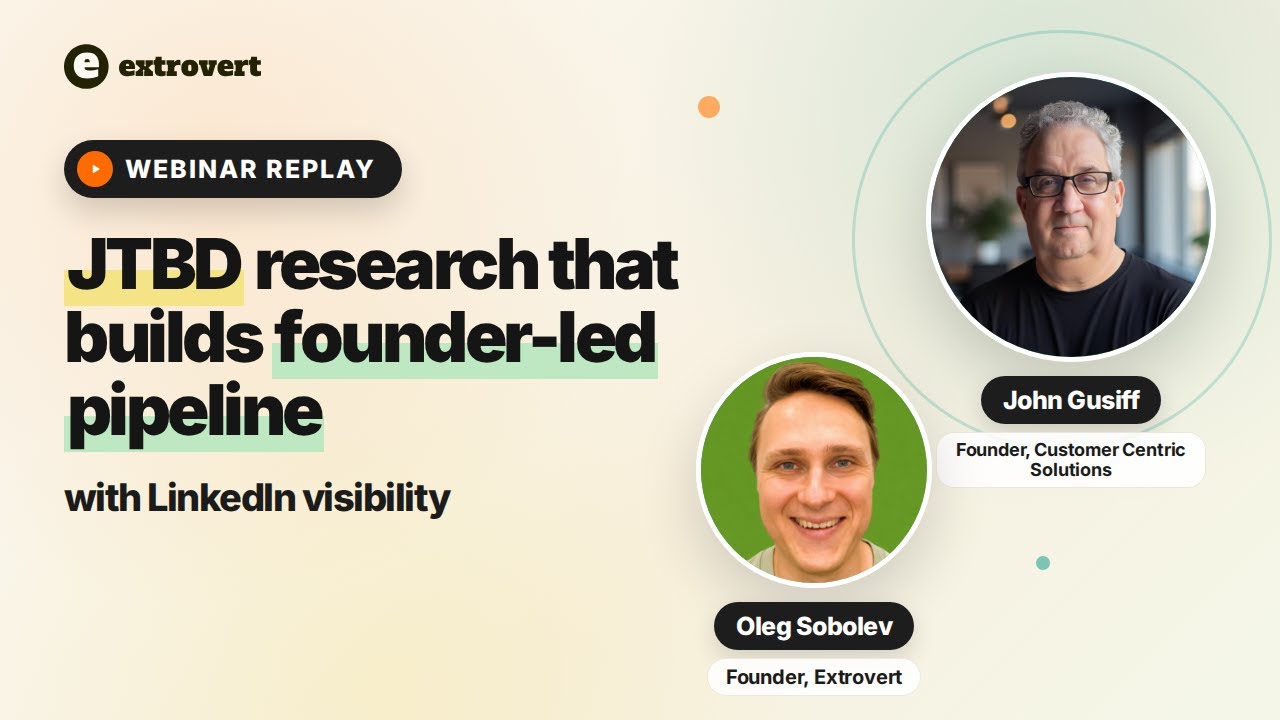
That was the core argument from John Gusiff, founder of Customer Centric Solutions, in a live session with Extrovert: your ICP isn't wrong, it's incomplete. The fix is to study what he calls customer progress, the Jobs-to-be-Done view of what a buyer is trying to accomplish and why now, then let that research drive what you post, who you engage, and what you say on LinkedIn. This is the written recap. You can watch the full replay here.
A firmographic ICP describes a target. Customer progress describes a buyer in motion. You need both, but only the second tells you what to say and when to say it.
Why cold outbound keeps losing power
John's starting point: cold outbound isn't necessarily "dead," but it has steadily lost strength, and the reason is structural. Most outreach talks about the product: what it does, the latest feature, who it serves. Buyers aren't moved by that. Buying decisions are emotional and motivational. People act on the degree to which a product helps them make progress: to become the leader they want to be, to earn their team's trust, to move from reactive to proactive.
You can't speak to that unless you've studied it. Warm engagement beats cold outreach precisely because it gives you the time and signal to learn what progress means to a specific buyer before you ask for anything. That's the foundation of warm outreach: get known, and get informed, before you pitch.
The three questions customer progress answers
A standard ICP sets the frame. Studying customer progress fills in the storyline behind it by answering three questions:
- What's changed? The triggering event: the first thought or struggling moment where someone recognizes that what they're doing no longer works. That recognition is the essence of demand. It can be a scaling event, a compliance shift, a leadership change.
- What does progress mean to them? They buy your product to accomplish an objective: move faster, reduce chaos, scale confidently. The job, not the tool.
- Why now? The market can be huge, but urgency and readiness are what matter. You're hunting for who is ready to move, not who merely fits.
Two frameworks: the wheel of progress and the four forces
John uses two JTBD-based lenses to study progress.
The wheel of progress
Think of it as a buyer's journey: first thought / struggling moment → passively looking → actively looking → deciding → hiring moment → consuming → assessing. Two details matter most. Passive looking and active looking are very different in time, energy, and the channels people use, so if you want to engage earlier in the funnel, you have to know what buyers do in each. And when buyers hire a new solution, they fire something else; studying both sides of that swap tells you what you're really competing against.
The four forces of switching
Adapted from Bob Moesta's model: for a switch to happen, the forces promoting progress must outweigh the forces blocking it. Most product decisions end in the status quo (you pitch for weeks or months and the buyer stays put) because the blocking forces win.
| Direction | Force | What it is |
|---|---|---|
| Promoting | Push | The pains, problems, and unmet needs driving them away from today |
| Promoting | Pull | The desire for new outcomes; the appeal of the new offering |
| Blocking | Habit / allegiance | Comfort with the current way; people dislike change |
| Blocking | Anxiety | Specific fears about the new product or switch |
| Blocking | Avoidance | Scars from prior bad purchases: poor service, weak performance |
When a qualified buyer goes quiet, it's rarely the pitch. It's that their habit, anxiety, and avoidance outweigh the push and pull. Good research tells you which blocking force to address, and which promoting force to amplify.
The "now you can" test for your messaging
John's simplest tool for fixing product-centric copy: the "now you can" test. Take any headline and try to preface it with "now you can." If it still describes what the product does, it fails. If it describes what the customer can now achieve, it passes.
Take Ramp, which does expense management. Product-centric: "real-time expense tracking." Progress-centric:
- Now you can go home at 5 p.m. because expenses are managed for you.
- Now you can trust your forecast, because every expense is accounted for.
- Now you can feel confident presenting to your executive team.
Jobs have a hierarchy: why sits above what above how. Progress-centric messaging speaks to the aspirational why and the outcome, not the task. (The same shift applies to your profile and posts; the fundamentals are in how to network on LinkedIn.)
One product, many destinations
To study progress at scale, John ran a synthetic-user research study on ClickUp, interviewing AI archetypes that represent hundreds or thousands of real people who share motivations, journeys, and concerns. He calls it qualitative at scale: LLMs are good at finding patterns and composites, so you can study whole populations far faster than with one-on-one interviews alone. (He mixes methods: synthetic, AI-moderated, and targeted human interviews.)
The study covered 15 organizations across roles (strategy/ops, product, engineering, marketing) and both decision makers and individual contributors. From 15 interviews he narrowed to five archetypes. The punchline: ClickUp is one product, but there were five different destinations for it. "Productivity and workflow" means different things to different people:
- A head of marketing: so I can feel in control, stop micromanaging, and focus on strategic leadership.
- A VP of operations: so I can move from reactive firefighting to proactive execution.
- A design lead: so I can create flow, protect creative quality, and lead more effectively.
Same tool, different progress. That is what a firmographic ICP can never show you.
Who's actually in motion: four signals
Your TAM can be large, but what matters is who's in motion now. John watches four signals to narrow focus to buyers worth engaging:
- The struggle is acute: something important is breaking or failing, so there's real motivation to change.
- Workarounds exist: they're already spending time and energy patching the problem, but the workaround won't scale.
- The search is active: they're visibly looking (LinkedIn engagement, site visits, events), not just passively aware.
- Time pressure is real: a triggering event has made this urgent; they need to move.
Much of warm engagement is about reaching people earlier, while they're passively looking, so that by the time they're actively looking, they already know who you are and you're in their decision set.
[Extrovert](https://goextrovert.com) tracks your prospects and the topics they care about, then suggests on-brand comments and DMs from your playbook, so you're already familiar when the buyer starts actively looking.
See how it works for B2B salesTurning research into LinkedIn action
Once you've studied progress, it informs five concrete LinkedIn decisions:
What conversations to start
Narrow from your full TAM to the people in motion: acute struggle, active search, real time pressure. Spend your energy there.
What to post
The better you understand the progress people want, the more relevant your posts. Three formats John uses, all aimed at language-market fit, speaking in the customer's own words:
- Pattern observation: "After working with 30+ marketing leaders, here's the pattern: by 6 p.m. on launch day, someone realizes the email team and social team were on different schedules."
- Reframing: "Most ops teams bought their stack one tool at a time. Each solved a real problem, but the stack itself is now the problem. Tool sprawl is a symptom."
- Customer story: "A head of product told me: after the third missed dependency this quarter, I stopped blaming the team. The system makes it impossible to see what depends on what until it breaks."
Who to engage
Not everyone is on LinkedIn, but someone in every org is. Engage across both levels, individual contributors and decision makers, because you never know your entry point, and you may need to give a champion the language to sell the CFO internally.
What to comment on
People show up on LinkedIn as posters, engagers, or lurkers. Tailor accordingly: comment to be visible to the audience you actually want to reach, in language tied to their goals, not your product.
What to DM
Build rapport through comments first, then DM with something meaningful and targeted, not salesy. Match the message to the buying stage and the person's behavior:
- To an engager: "Noticed your comment on that dependency-management post. It matches a pattern I keep seeing."
- To a poster: "Saw your post on the launch-coordination breakdown. Happy to share what's worked."
Don't send hiring-stage messaging to someone who's only passively looking. Read the stage, then match the stance.
Match the marketing objective to the stage
Your goal changes by where the buyer is in the wheel:
- Struggling moment: grab attention by nudging the pain.
- Passively looking: activate the goal by highlighting what they should want to achieve.
- Actively looking / deciding: drive desire by making the case for your offering.
Same buyer, different objective and language at each step. You can only make that land because you studied real people moving through the journey.
"Talk to your users" isn't enough. Study the whole journey, before and after they hired you, and play their own language back to them. That's what turns a thin ICP into messaging that moves people.
Watch the full session
The replay walks through the ClickUp case study, the frameworks, and the audience Q&A in detail, plus the slide deck.
John is also an Extrovert done-for-you partner. If you want research-informed positioning and targeting built for you, that's where to start.
FAQ
What's wrong with a firmographic ICP?
Nothing. It's just incomplete. Industry, size, and stage tell you who to target, but not who's ready to buy. They leave out urgency, tension, and switching readiness, which is what customer-progress research adds.
What is Jobs-to-be-Done in B2B sales?
Jobs-to-be-Done studies the progress a buyer is trying to make, the objective behind the purchase, rather than the product's features. In B2B it means understanding the triggering event, the desired outcome, and the "why now" for each role in the buying group.
What are the four forces of switching?
The four forces are push and pull (promoting change) versus habit/allegiance and anxiety/avoidance (blocking it). A buyer only switches when push and pull outweigh habit and anxiety, which is why most deals end in the status quo.
What is the "now you can" test?
It's a quick check for messaging: preface your headline with "now you can." If the result still describes what your product does, the copy is product-centric and fails. If it describes what the customer can now achieve, it's progress-centric and passes.
How do I know which prospects are worth engaging?
Look for four signals that a buyer is in motion: an acute struggle, existing workarounds, an active search, and real time pressure. These mark people likely to act, versus a large but passive TAM. Tools like Extrovert help you engage them early through comments and DMs.
What are synthetic personas?
Synthetic personas (or archetypes) are AI-generated research subjects that represent populations of real people with shared motivations and buying journeys. John uses them as "qualitative research at scale" to study many roles and industries quickly, then validates with human interviews.
Based on Extrovert's live session with John Gusiff (Customer Centric Solutions), "Your ICP isn't wrong, it's incomplete." Watch the replay.